Japan-easy - Season 1

Season 1

Episodes
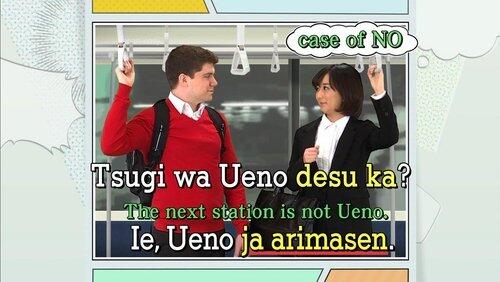
#1 Basic sentences: A is B (Part1)
"Next is Ueno Station", in Japanese is "Tsugi wa Ueno desu". Ending a sentence with "desu" is a basic pattern, so how about using this pattern in various situations, and taking the first step towards communicating in Japanese?

#2 Basic sentences: A is B (Part2)
When saying "My name is Tanaka", in Japanese, after the part that means "My name", we put "wa" particle. If the other person's name is also Tanaka, "wa" particle replaces "mo" article. Mastering this rule can take your Japanese one step further.
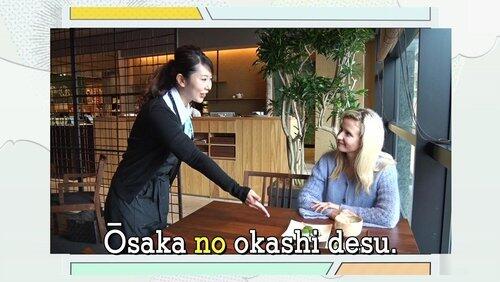
#3 Talking about ownership
Today, we will focus on "no", the article used between 2 nouns. By saying "A no B", you're saying that A owns B. When the video is over, you'll learn various expressions that have "no" article.
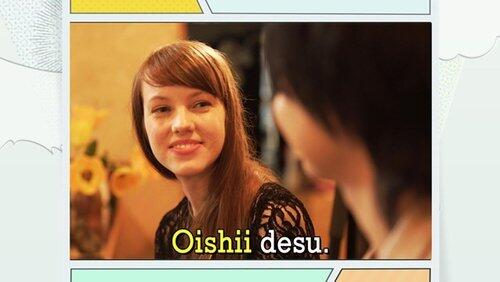
#4 Expressing your impressions or feelings
Today, we'll learn how to express our impressions or feelings by using adjectives such as "oishii" (tasty), "kireina" (beautiful), "shizukana" (quiet or calm) and so on. In the Phrase-easy segment, we'll introduce "Itadakimasu", the phrase we say before meals.

#5 Words like this, that, and it
In this episode, we'll focus on "kore", "sore" and "are", 3 words that correspond to "this", "it" and "that". We'll learn the basic usage of these words, and then move on to "dore", a word used to ask about one item among several.
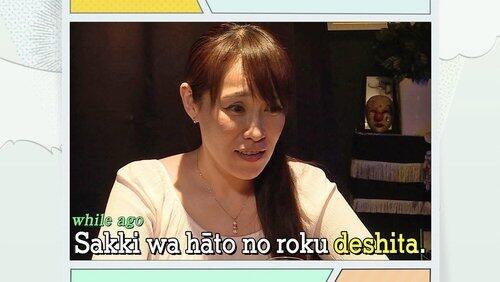
#6 Past sentences (Part1)
In this episode, we'll learn the word "deshita", which refers to the past. This word helps us to share our personal experiences with others. We'll also learn the word "daijobu", one of the most commonly used words in daily Japanese conversations.

#7 Past sentences (Part2)
In this episode, we'll focus on "deshita", a word we can use when expressing past feelings or impressions. We'll also look at a common sentence pattern: na-adjectives + "deshita".

#8 Negative sentences
In this episode, we'll focus on the negative form of adjectives. For example, the phrase "oishi desu", meaning "(It) is delicious", becomes "oishiku nai desu", meaning "(It) is not delicious".

#9 Talking about action (Part1)
In this episode, we'll go over verbs that express action. For example, to run is "hashiri masu", to eat is "tabe masu". And to eat something becomes "…o tabe masu".

#10 Talking about action (Part2)
Today's expressions are "ikimasu", meaning "to go", and "kimasu", meaning "to come".
We'll also learn how to make a sentence using the words "e" to express destinations, "ni" to say the time and "de" to describe the method of transportation. In the kanji corner we'll look at kanji that express numbers.

#11 Talking about action (Part3)
Today, we'll learn the past tense and negative forms of verbs by watching Japan's national sport - sumo. As we've learned before, when saying what time an action takes place, you add "ni" after the time.
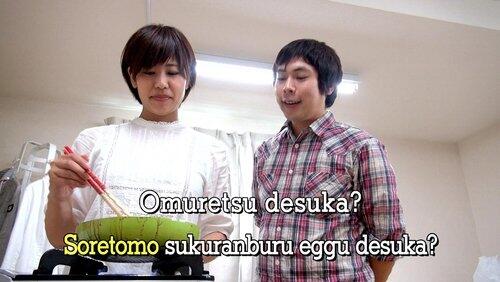
#12 Asking if something is A or B
Today, we'll learn how to ask whether something is either A or B.
"Omuretsu desuka? Soretomo sukuranburu eggu desuka?" The word "soretomo" is similar to the word "or" in English. When presenting another option, we use "soretomo".

#13 Saying that someone is there
Today, we will learn how to talk about something you find or see.
Detective Michael heads to the secret hideout of a dangerous criminal. He finds some clues to solve the crime, and then he talks to his partner over the radio. Take a look at how he tells his partner about what he saw and what is there.
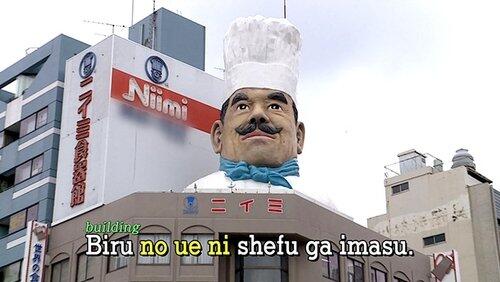
#14 Saying that something is there
Today, we'll learn how to explain in detail where something or someone is.
This lady is meeting her boyfriend in Asakusa. Let's check out their conversation about going shopping. There are some words that describe position in their conversation. Let's check it out.

#15 Saying you're sick
Today, we'll learn about how to talk about our health and how we're feeling. In the video, a man tells the doctor that he has a headache and a fever. And a woman tells the doctor that her stomach hurts. Communication with the doctor is very important for an appropriate diagnosis. Let's learn how we can tell someone about the various ways we might feel.

#16 Expressing what you want
Today, we're going to go over some expressions used to say that you want something. One afternoon, a couple is watching a TV shopping show. The wife sees a white refrigerator, and she says, "I want that". But they just bought a new refrigerator one week ago...
Let's see how the husband responds to his dear wife's wish.

#17 Expressing what you want to do
Today, we'll go over how to express your desire and to say you want something. In the video, a couple is on a date at Tokyo Tower. The man asks the woman what she wants, and he grants her wishes one after another, to her delight. Let's see how they express their desires and explain what they want.
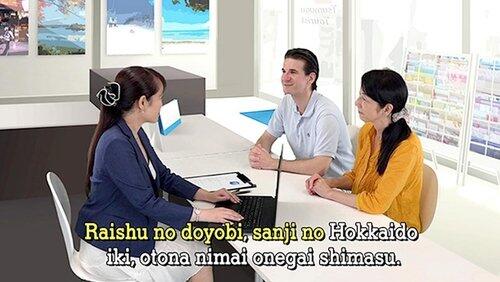
#18 Using time words
Today we'll learn how to talk about the past, like yesterday and the day before. In the video, detective Michael is investigating a crime that occurred 3 days ago. He asks the suspect what he has been doing in the past few days. Will Detective Michael be able to find the culprit? Let's see what happens!

#19 Comparing two things
Today we'll learn how to compare two items and how to choose one of several items. When comparing two items, we use the word "docchi". And when choosing one of several options, we use the word "dore". In English, both words can probably be translated as "which".
In the video, the quizmaster asks questions to that require comparing and selecting. Let's focus at the conversation between him and the contestants.

#20 Inviting someone to do something
Today we'll learn to make a suggestion to someone by adding "ka" to the negative form of a verb. In the video, a man wants to invite that he and his colleagues all go to dinner together. "Ikimasu" means "go". The negative form of "ikimasu" is "ikimasen". Let's check out the video to see how it's used.
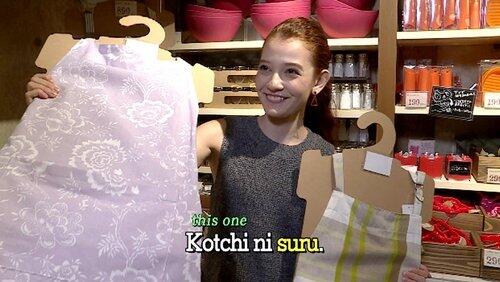
#21 Formal and casual ways of talking
Today we'll learn about the polite and casual ways of speaking. First, let's look about the verb for "do" as in "to do something". In this case "shimasu" is polite and "suru" is the casual form. Now let's watch the video and focus on how these words are used.

#22 Talking about giving and receiving (Part 1)
Today we'll learn expressions used when giving and receiving something. "Agemasu" means "to give" in English, and "moraimasu" means "to receive".
And there's another expression for receiving things: "kuremasu". Now let's watch the video and see how these expressions are used.

#23 Talking about giving and receiving (Part 2)
In this episode, we will learn 2 common endings for verbs: "kureru" and "ageru". "Kureru" is mostly used when someone gives you something. "Ageru" is used mostly when you give something to someone. The word "kau" means "to buy", so "kattekureru" is often used when someone buys you something, and "katteageru" is often used when you buy something for someone.
So now learn more about this expressions from the video!
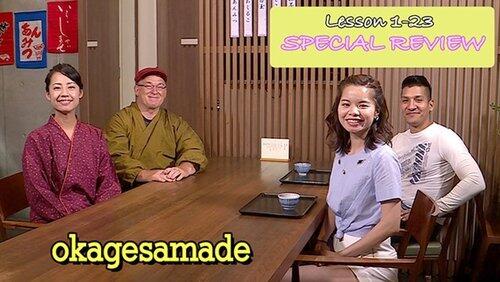
#24 Review
In this episode, Detective Michael uses several of the expressions that we've learned. First, he uses the expression "desu" to ask about the type of ramen the man is eating. Let's listen for both the question form and the negative form in the conversation. In the next scene, let's check out how to use "ano", "kono" and "asoko" to describe the position of something. Finally, let's review how to express a desire and how to invite someone. Can Detective Michael invite his wife to Tokyo Tower?
Let's enjoy the story and review what we've learned so far!
Recently Updated Shows

The Creep Tapes
Based on a collection of videotapes in the secret vault of the world's deadliest and most socially uncomfortable serial killer, who hires his victims to film him for the day under false pretenses, each episode exposes a new victim from one of the fabled 'Creep Tapes'.

America's Funniest Home Videos
ABC's longest-running primetime entertainment show, America's Funniest Home Videos, returns for season 36 this fall with the same mission -- giving families something genuinely funny to enjoy together on Sunday nights.
"AFV," the longest-running primetime entertainment show in ABC history, returns for season 36 with the same mission - to provide viewers with hysterical moments that fly by at a dizzying pace.

The Real Housewives of Potomac
Just up the river from our nation's capital lies a hidden gem—Potomac, Maryland. Its rolling hills, gated mansions, sophisticated prep schools, and exclusive country clubs all serve to keep the area invitation-only. Sprinkled throughout this community are a handful of old-line, wealthy African-American families who have historically broken racial barriers to provide a life of privilege for their children. The Real Housewives of Potomac follows the upscale lives of six intriguing, well-to-do women: Gizelle Bryant, Katie Rost, Karen Huger, Charrisse Jackson-Jordan, Robyn Dixon, and Ashley Darby, all of whom have fought for their places in this society by way of legacy or marriage. In a town where entry is granted only through class, pedigree, and lineage, how far will these ladies go to secure their spot at the top of this prestigious circle?

The Traitors Canada
Follow a group of contestants – including some familiar faces – who live together as they complete a series of challenges with the goal of earning a cash prize. The catch? Some of the contestants are traitors who will attempt to deceive and manipulate their way to the prize instead of sharing it amongst the group. In this psychological adventure will the traitors be unmasked in time?
