America's Secret Slang - Season 2
Season 2

Episodes
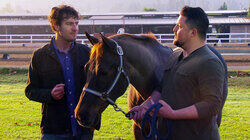
Straight from the Horse's Mouth
In this episode, we look at the ways that American English has been transformed by animals, food, sports--and death. Ever wonder why we say "that's a horse of a different color" or "that's for the birds"? Why do we "chew the fat" when we talk or "put up our dukes" when we fight? And why, when we die, do we "kick the bucket"? All these terms show the ways that American English has evolved and mutated through the animals we raise, the food we eat, the games we play and the end we want to avoid. Zach Selwyn hosts.
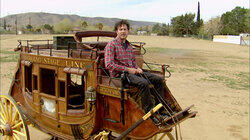
Riding Shotgun
Every day we use words and phrases that come from deep within our history. Their origins reveal a lot about us and where we came from, but most of us have no idea what these terms originally meant. In this episode we look at how forms of transportation from horses to trains to cars, and different intoxicating substances from opium to booze, influenced the common words and phrases we say every day. Why do insensitive people "ride roughshod" over others, while lucky people ride the "gravy train?" Who put the jay in "jaywalker," and the bus in "busboy?" Why are "highways" high, what do "turnpikes" turn, and why is a wild person "hell on wheels?" When it comes to substances, who put the hero in heroin, the junk in junkie, and the ooze in booze? And what's the connection between George Washington and the words grog and groggy?
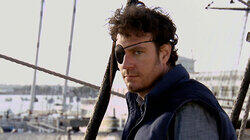
Lower the Boom
In this episode, we look at the ways that American English was transformed by the high seas, the ancient world, the movers and shakers of big business, and the news industry. Ever wonder why we're "pooped" when we're tired? Or say that a drunk is "three sheets to the wind"? Why do we say our "ears are burning" if someone's talking about us, and why is October the 10th month, even though its name means "8th"? Why is a rich, powerful person called a "tycoon"? And why are those supermarket scandal sheets called "tabloids"? All these terms show the powerful impact that sailing, big business, the ancient world and the news media have had on American English.
Off the Cuff
In this episode, we look at the ways that American English has been transformed by the clothes we wear, the crimes we commit and the punishments we receive, the insults we use...and the internet. Ever wonder why, when we "speak off the cuff," we're "flying by the seat of our pants"? Why is a street robbery called a "mugging," and does "blackmail" really have anything to do with mail? What's the difference between a "nerd" and a "geek," and who was the first person to use "OMG"? All these terms show the ways that American English has built up a wardrobe of words by begging, borrowing and stealing.
Cut to the Chase
In this episode we look at how entertainment from circuses and vaudeville to plays and movies, influenced the common words and phrases we say every day. How did bad actors give us the word "explode," rude actors give us the phrase "to upstage" someone, and superstitious actors give us "break a leg?" How did the circus give us words like "jumbo" and "Siamese twins," and the idea that politicians "jump on the bandwagon?" Why did vaudeville invent "deadpan" humor, "slapstick" comedy and "off color jokes?" And how did the movies give us expression like "cut to the chase" and "cliffhanger?"
Bite the Bullet
In this episode, we look at words from the worlds of the military, police, aviation, and baseball. Ever wonder why a "last ditch effort" rarely involves digging an actual ditch? Or why a temporary worker is hired as a "freelancer"? How did the army tank get its name? Why do we shoot at a bulls-eye, and is it "duct" tape or "duck" tape? When a test pilot "pushes the envelope," what envelope is his pushing? What's the connection between one of America's outlawed sports, and the front of every plane? Words that started on the baseball diamond have spread to aspects of our everyday life. Why is a "southpaw" so named, not just in baseball, but in life? And if you want to see a bunt, the old ball yard isn't the only place for that... All these words and phrases show the richness and depth of our language. If you just know where to look.
Go for Broke
In this episode, we look at the ways that American English has been transformed by the Vikings, the Cold War, computers, music, gambling, and the different meaning we give to the colors of the rainbow. Why is a "red letter day" good, but being "in the red" is bad? Why do we "boot up" a computer? What's a "jackpot" and why do we "hit" it? Did the term "Cold War" really begin in the Middle Ages? And what's the original meaning of the Viking word "thing"? All these terms show the ways that American English has been invigorated by crises from Viking invasions to the threat of nuclear war, and inspired by the colors we see, the music hear...and the money we lose in bets. And they prove that when it comes to our unique American language, we speak our history every day. If you just know where to look.
Hail to the Chief
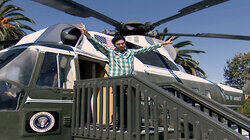
In this episode, we look at the ways that American English has been transformed by American presidents, by the language of sex and romance, by good and bad manners. We'll also explore how easy it is to insult people of different groups without even realizing it. Did you know who invented the phrase Founding Fathers, and what the Founding Fathers originally called themselves? Or how American presidents popularized terms like "three martini lunch," "lunatic fringe" and "keep the ball rolling?" When it comes to insults, did you know that the cheer "hip hip hurray" was originally anti-Semitic, "hooligan" was anti-Irish, and the phrase "in cahoots" was anti-French? When it comes to sex, how did a diet of meat give us the word "mating," why do young men "sow their wild oats," and why is the word "hysterical" an insult to women? And when it comes to manners, we'll explore the strange roots of words like "posh," "snob," "stuck up" and even "hello" and "goodbye."
Recently Updated Shows

NCIS
NCIS (Naval Criminal Investigative Service) is more than just an action drama. With liberal doses of humor, it's a show that focuses on the sometimes complex and always amusing dynamics of a team forced to work together in high-stress situations. Leroy Jethro Gibbs, a former Marine gunnery sergeant, whose skills as an investigator are unmatched, leads this troupe of colorful personalities. Rounding out the team are Anthony DiNozzo, an ex-homicide detective whose instincts in the field are unparalleled and whose quick wit and humorous take on life make him a team favorite; the youthful and energetic forensic specialist Abby Sciuto, a talented scientist whose sharp mind matches her Goth style and eclectic tastes; Caitlin Todd, an ex-Secret Service Agent; and Timothy McGee, an MIT graduate whose brilliance with computers far overshadows his insecurities in the field; Assisting the team is medical examiner Dr. Donald "Ducky" Mallard, who knows it all because he's seen it all, and he's not afraid to let you know. From murder and espionage to terrorism and stolen submarines, these special agents travel the globe to investigate all crimes with Navy or Marine Corps ties.
Landman
Set in the proverbial boomtowns of West Texas, Landman is a modern day tale of fortune seeking in the world of oil rigs. The series is an upstairs/downstairs story of roughnecks and wildcat billionaires fueling a boom so big, it's reshaping our climate, our economy and our geopolitics.

The Creep Tapes
Based on a collection of videotapes in the secret vault of the world's deadliest and most socially uncomfortable serial killer, who hires his victims to film him for the day under false pretenses, each episode exposes a new victim from one of the fabled 'Creep Tapes'.

America's Funniest Home Videos
ABC's longest-running primetime entertainment show, America's Funniest Home Videos, returns for season 36 this fall with the same mission -- giving families something genuinely funny to enjoy together on Sunday nights.
"AFV," the longest-running primetime entertainment show in ABC history, returns for season 36 with the same mission - to provide viewers with hysterical moments that fly by at a dizzying pace.
The Real Housewives of Potomac
Just up the river from our nation's capital lies a hidden gem—Potomac, Maryland. Its rolling hills, gated mansions, sophisticated prep schools, and exclusive country clubs all serve to keep the area invitation-only. Sprinkled throughout this community are a handful of old-line, wealthy African-American families who have historically broken racial barriers to provide a life of privilege for their children. The Real Housewives of Potomac follows the upscale lives of six intriguing, well-to-do women: Gizelle Bryant, Katie Rost, Karen Huger, Charrisse Jackson-Jordan, Robyn Dixon, and Ashley Darby, all of whom have fought for their places in this society by way of legacy or marriage. In a town where entry is granted only through class, pedigree, and lineage, how far will these ladies go to secure their spot at the top of this prestigious circle?